
FORN journal
The Tjørnuvík sword pommel
A small object with a much larger story. A possible trace of the 11th or 12th century, connecting the Faroes with the British Isles.
Photo: Jan Hammer Egholm
Explore the object in 3D
A different view of the same object, hosted by Sketchfab.
Svørðknøttur úr Tjørnuvík
Turn the object. Look closer.
Preview photograph: Jan Hammer EgholmSketchfab receives your IP address and device details when you load the viewer. No Sketchfab connection is made before you choose to load it.
3D model by Faroe Islands National Museum
Open on SketchfabFAROE ISLANDS / ARCHAEOLOGY
The Tjørnuvík pommel
A possible 11th-12th-century pommel from the British Isles
Found by Jan Hammer Egholm | 29 October 2022 All photographs: Jan Hammer Egholm
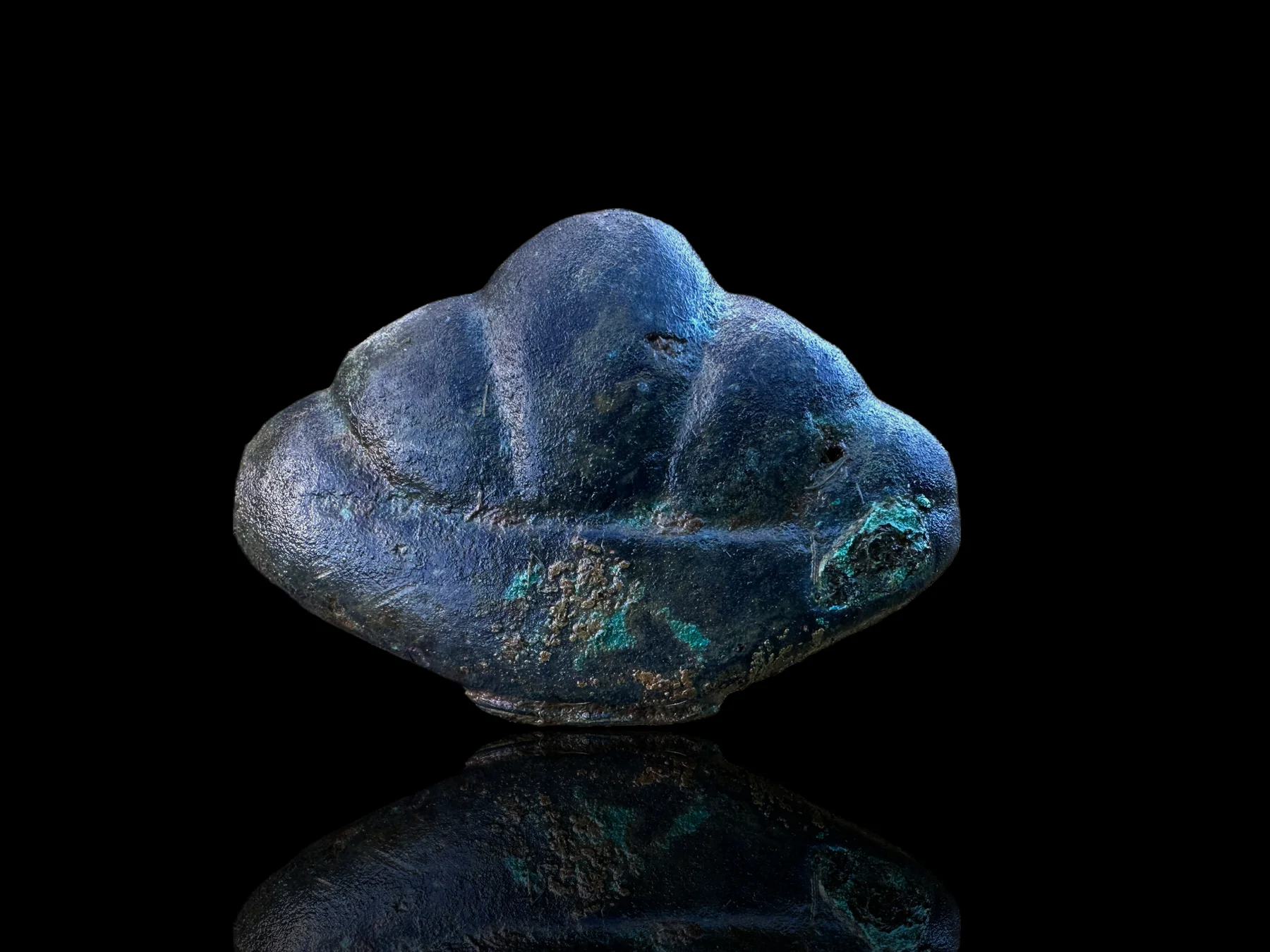
The surviving face: a large central lobe, two smaller lobes on each side and a broad curved lower band. The proposed identification and date remain provisional. Photo: Jan Hammer Egholm.
On 29 October 2022, Jan Hammer Egholm found this object with a metal detector in Tjørnuvík, Faroe Islands. Shortly afterwards, Tomáš Vlasatý saw Egholm’s Facebook post with photographs of the pommel and offered an assessment. But why is one broad side open, and what could it reveal about how the object was made? [14, 17]
After seeing Egholm’s photographs, Vlasatý identified the pommel as a variant outside Petersen’s typology, made in the British Isles. His personal dating estimate points to the 11th-12th centuries, approximately AD 1000-1200. This is an assessment of photographs rather than a physical examination. [17]
The missing side may be the key to understanding the object.
Vlasatý’s assessment shortly after the find
According to Jan Hammer Egholm, Vlasatý made the following comment shortly after the discovery on 29 October 2022, having seen the photographs in Egholm’s Facebook post. The precise date of the comment has not been supplied. [17]
Let me tell you this is a category that stands outside the Petersen typology. The variant was made in British Isles, my personal guess is the dating points to 11th-12th c.
Tomáš Vlasatý; early assessment of photographs, quoted as supplied by Jan Hammer Egholm. [17]
What the assessment tells us
Vlasatý identifies three features of the attribution: a category outside Petersen’s typology, manufacture in the British Isles, and a personal dating estimate of the 11th-12th centuries. The date is an informed estimate, not a measured result. [17]
This directs the search toward comparable British Isles pommels, especially examples from the 11th and 12th centuries. The proposed period spans the later Viking Age and the following medieval period, rather than supporting an exclusively Viking-age label. [17]
Who is Tomáš Vlasatý?
Tomáš Vlasatý is the author and editor of Project Forlǫg, an online publication about early medieval material culture and historical reconstruction. His published work includes "Bronze Anglo-Saxon Sword Pommels" (2018), directly relevant to the classification difficulties raised by this find. [18, 19]
That background makes his comment especially relevant. His published article provides comparative context; the quoted correspondence is the source of his specific view of the Tjørnuvík pommel. The two should not be confused.
Vlasatý also described the lower hole as visible and expected, as discussed beside the lower-edge photograph below. Neither quotation determines the alloy or explains the entire open broad face. These are comments on photographs, not a museum examination report. [17]
Discovery, reporting and the wait for investigation
Jan Hammer Egholm found the object and took all the photographs reproduced in this article. The account of its discovery, reporting and handover comes from him. [14]
Reported within 15 minutes
Egholm states that Tjóðsavnið, the Faroe Islands National Museum, was informed approximately 15 minutes after the find. The pommel was subsequently delivered to the museum for inspection. The handover date has not been specified. [14]
Status as of 6 September 2026
According to Egholm, Tjóðsavnið had still not investigated the pommel as of 6 September 2026, nearly four years after its discovery. This is the finder's account; the museum's internal investigation status has not been independently verified for this publication. [14]
The associated 3D-model link should not be confused with an examination report. Documentation, specialist identification, conservation and material analysis are different activities. Vlasatý’s separate assessment concerns the photographs; it does not establish what the museum has or has not examined. [17]
Why a documented assessment matters
The Faroe Islands have extensive evidence of Viking-age settlement and activity. Published research describes sites including Kvívík, Toftanes and Sandur; Tjóðsavnið itself presents the Viking-age farmstead at Toftanes. This is the wider archaeological setting for investigating a sword fitting that may date from the later Viking Age or the following medieval period. [15, 16, 17]
Egholm says that, to his knowledge, there are no other recorded Viking-age weapon finds from the Faroe Islands. That statement is retained as his understanding, not as a verified inventory of the national collection. A claim that this is the first such find requires confirmation against museum registers and published excavation records. [14]
A confirmed identification could make the object an important addition to the evidence for early medieval weaponry in the islands. Vlasatý’s proposed 11th-12th-century date also means that a "first Viking-age weapon" claim would require both a verified date and a review of the museum records. A documented assessment remains the priority. [14, 17]
What are we looking at?
A pommel is the fitting at the end of a sword grip, opposite the blade. In this case, "pommel component" is the important phrase: the object may preserve only the outer part of what was once a more complicated assembly.
The surviving face has a large central lobe, an intermediate lobe on either side and two smaller outer lobes. Beneath them sits a substantial curved band. This combination provides the starting point for comparison with Viking-age and early medieval sword fittings.
The band is worth examining as carefully as the lobes. A visible line divides the two areas, but a line is not necessarily a joint. It could be decoration within a single casting, the boundary between separate parts, or a feature obscured by corrosion. The photographs do not settle which.
There are also small irregular perforations, green patches and yellow-brown areas. These are real observations; their causes and composition are not yet established. No secure inscription or named decorative style can be identified from the supplied photographs. [13]
How old might it be?
Vlasatý provisionally places the pommel in the 11th-12th centuries, approximately AD 1000- 1200. His wording makes clear that this is his personal estimate from the photographs, not a precise year or a firm chronological boundary. [17]
The Fetlar and Sheepy pommels are dated to approximately AD 900-1100. Skeffington and Solihull have earlier catalogue dates. Although these objects share some features with the Tjørnuvík find, their dates cannot simply be transferred to it. Construction and attachment must also be compared. [1-4]
Nor did lobed pommels disappear at one precise historical moment. York Museums Trust dates the Cawood sword, with its five-lobed Viking-style pommel, to AD 1080-1120. It is not an exact material or constructional match, but it warns against treating a Viking-looking outline as a narrow date stamp. [5]
Vlasatý explicitly places this category outside Petersen’s system, rather than assigning it to type L or another Petersen letter. His published study of cast Anglo-Saxon pommels discusses related classification difficulties. "Outside the typology" is not the same as "without historical parallels". [17, 19]
A suitable provisional description is: "Sword-pommel component attributed by Tomáš Vlasatý to a British Isles variant outside Petersen’s typology; provisionally dated by him to the 11th-12th centuries." This dates the proposed manufacture, not the moment of loss or deposition. [17]
Where could it have been made?
Vlasatý identifies the British Isles as the place where this variant was made. This is a specialist attribution based on the photographs, not a proven workshop location. [17]
An end view reveals the depth and rounded relief of the lobes. A matching front outline alone is not enough to establish the original construction. Photo: Jan Hammer Egholm.
Vlasatý names the British Isles without specifying a smaller production area. It would therefore be premature to assign the object to England or a particular town. "Anglo-Scandinavian" is useful for discussing related forms and craft traditions, but it does not identify the nationality of the owner or the maker of a missing blade. [6, 17]
The Fetlar comparison is particularly interesting because it places a similar five-lobed copper- alloy form in another North Atlantic island setting. It does not establish that the Tjørnuvík object travelled through Shetland, belonged to the same workshop tradition or followed a particular sea route. [1]
This is also why the surviving side profile matters. Two objects may resemble each other from the front while differing in depth, base curvature or attachment. A useful comparison has to explain those differences, not merely place two crown-like outlines side by side. The present lack of reliable dimensions is a practical limit, not a minor omission.
The proposed attribution is therefore a probable British Isles origin for the pommel variant, following Vlasatý. The workshop, precise locality and route to the Faroes remain unknown. His comment concerns the pommel; it does not identify the manufacture, inscription or smith of the missing blade. [17]
Why is one side open?
The open reverse is the key puzzle. The cavity appears to extend across a broad face, not just the narrow underside. The support below is modern equipment, not part of an ancient handle. Photo: Jan Hammer Egholm.
Vlasatý’s remark that a hole was visible and expected relates, in the context supplied by Egholm, to the lower opening. It should not be extended to the whole open reverse. The photograph here appears to show a much larger opening across a broad face. The explanations below remain hypotheses, not conclusions established by his quotations. [13, 17]
Hollowness itself is not unusual. Published early medieval pommels demonstrate that an attractive metal exterior did not always mean a solid lump of metal. The Metropolitan Museum records a late ninth-century Anglo-Saxon pommel with a copper-alloy shell on an iron core. A technical study of the Gamla Ingla pommel in Sweden describes a hollow casting made around a clay core. These are different kinds of construction, not interchangeable explanations. [7, 8]
A clay casting core helps create a cavity during manufacture. A structural iron core can remain part of the finished object. Neither has been identified inside this find, and the dark material visible in its cavity cannot be named from a photograph.
Some historical pommels sat above a separate upper guard or base. Losing that element could expose the narrow underside. It would not, on its own, explain the apparent absence of a whole broad face. The opening must be understood in relation to the object's three-dimensional shape. [6, 13]
A hollow pommel can be intentional. The apparent absence of an entire broad face still needs explaining.
Two explanations worth testing
A missing wall
The object may once have had two broad faces enclosing a hollow interior. One face and much of the surrounding edge survive; the opposite wall has broken away or deteriorated. Broken margins, changes in surviving wall thickness or small stubs of the missing face would support this interpretation.
The published Sheepy photographs show a smaller breach through a pommel face into its hollow body. This is a useful visual analogy, not an identical break pattern and not evidence of battle damage. The cause and timing of damage to the Tjørnuvík find remain unknown. [3, 13]
A separated casing
Alternatively, the surviving piece may be an outer component detached from a backing, core or adjoining part. A deliberately finished seating edge, a consistent join or remnants of attachment points would favour that explanation. Composite pommels are documented, but an exact matching one-sided casing has not been established for this object. [7, 13]
The lower-edge opening and reddish-brown material, described by Egholm as iron rust. Vlasatý called the hole visible and expected; its attachment and material still need examination. Photo: Jan Hammer Egholm.
According to Egholm, Vlasatý made this further comment about the opening beside the reddish material at the bottom of the pommel: [17]
The hole was visible and expected 🙂
Read in this context, the remark treats the hole as an expected feature, not automatically as damage. It does not identify the reddish material, confirm a surviving tang or fastener, or explain the open broad face. The lower opening and the broad reverse opening must be assessed separately. [13, 17]
What can the surface tell us?
The green patches make a copper-bearing material plausible. They do not distinguish bronze from brass or establish the original proportions of the alloy. "Copper alloy" is therefore the safer working term. Even analytical results from a corroded surface require care, because that surface may not represent the uncorroded metal beneath it. [11]
The yellow-brown patches are another tempting clue. They could represent exposed alloy, deposits or a coating. They are not proof of gold. Microscopic examination and targeted analysis could test the possibility of gilding, but no such result is available for this assessment. [13]
Nor should irregular surface marks be promoted into runes, animal ornament or a maker's signature. Controlled photographs under different lighting would help separate repeated intentional marks from reflections and corrosion. Until then, the decoration remains unresolved.
Tjørnuvík: a meaningful setting, not a proven association
The village already has a documented Viking-period archaeological context. Sverri Dahl and Jóannes Rasmussen's 1956 report describes a burial at Tjørnuvík and a ring-headed bronze pin of a type associated with Scotland and the wider Insular world. The published account attributes the burial to the tenth century. [9]
This establishes an earlier local archaeological setting, not a date or an association for the pommel. With Vlasatý’s 11th-12th-century estimate, the proposed manufacture may post-date the burial. No link with that grave, human remains or a securely dated archaeological layer has been demonstrated. [9, 17]
The distinction matters. A famous nearby discovery can help explain why a new find is interesting, but it cannot supply a context that was never recorded. The photographs do not establish a battlefield, a ceremonial offering, a workshop deposit or the identity of an owner. [13]
A British Isles attribution offers a direction for research, not a complete story about an owner.
What could resolve the mystery?
Vlasatý’s assessment makes the next comparisons more focused: examples of the British Isles variant he recognises should be examined alongside the object’s construction. The open rim must still be identified as broken metal, a manufactured seating edge or a margin obscured by deposits. [17]
X-radiography could help locate concealed metal remnants, joints and attachment features. It is an established method for investigating archaeological metalwork without first removing all the surrounding deposits. The rectangular lower-edge feature would be a particular target. [10]
Material analysis could test the alloy and any coating, while measured photographs and a scaled 3D record would allow proper comparison of proportions. The object's dimensions, weight and any existing museum conservation record are more informative than an estimated size against a glove or detector.
The find photographed on a metal-detector controller. The controller provides context but is not a calibrated archaeological scale. Photo: Jan Hammer Egholm.
A story that is not yet finished
Vlasatý’s assessment points to a British Isles sword-pommel variant outside Petersen’s typology, provisionally dated to the 11th-12th centuries. His further remark recognises an expected hole at the bottom. A missing wall and a separated casing are possible explanations for the open broad face, but neither is established by his comments. [13, 17]
The next step is a documented examination of the object itself. Its edges, attachment features, lower opening and materials could help establish how it was made and assembled. That is the route toward understanding what this find may reveal about weapons and connections in the medieval Faroe Islands.
Sources and further reading
Research basis: This AI-assisted article draws on Jan Hammer Egholm’s photographs and account of the discovery, comments from Tomáš Vlasatý, and published sources. It is not a Tjóðsavnið examination report. According to Egholm, Vlasatý’s assessment followed shortly after the discovery in 2022. Museum-status information is Egholm’s account as of 6 September 2026. No photographic detail has been reconstructed. [13, 14, 17]
Preserving the evidence: leave cleaning and treatment decisions to an archaeological conservator. Polishing removes metal and may erase useful surface detail. [12]
[1] Shetland Museum & Archives. Jenny Murray, "Viking Age Sword Pommel - an exciting addition to our collection" (27 January 2025). Fetlar: material, form, construction and AD 900-1100 attribution.
[2] University of Nottingham: Skeffington. Vikings in the East Midlands, "Sword Pommel (LEIC-6D2448)". Recorded Anglo-Scandinavian comparison, approximately AD 850-1066.
[3] University of Nottingham: Sheepy. Vikings in the East Midlands, "Sword Pommel (NARC-E7AAF4)". Comparison dated approximately AD 900-1100; photographs show a breach through part of a face.
[4] Portable Antiquities Scheme / Europeana. "Early Medieval Sword", WMID-31CFC2, Solihull. Hollow five- lobed copper-alloy pommel, attributed to the ninth-tenth century.
[5] York Museums Trust. "Cawood Sword", YORYM: 2007.3086. Five-lobed Viking-style pommel on a sword dated AD 1080-1120.
[6] Jostein Aksdal. "Dei anglosaksiske sverda: L-typesverd i England og Skandinavia", Viking 80 (2017), pp. 59- 88. DOI: 10.5617/viking.5474.
[7] The Metropolitan Museum of Art. "Sword Pommel", accession 2005.344. Late ninth-century Anglo-Saxon copper-alloy shell, with silver and niello, on an iron core.
[8] Ny Björn Gustafsson. "A spectacular sword pommel from Gamla Ingla, Uppland", Fornvännen 119(1) (2024), pp. 64-67. Technical account of a hollow casting.
Sources and credits (continued)
[9] Sverri Dahl and Jóannes Rasmussen. "Víkingaaldargrøv í Tjørnuvík", Fróðskaparrit 5 (1956). DOI: 10.18602/fsj.v5i.267. Primary burial report; not an association with this pommel.
[10] English Heritage / Historic England. Vanessa Fell, Quita Mould and Rob White, Guidelines on the X- radiography of Archaeological Metalwork (2006).
[11] Historic England research-report archive. Justine Bayley, Qualitative analyses of some copper alloy objects from Blackfriars Street, Carlisle. Corroded-surface XRF limitations.
[12] Canadian Conservation Institute. The Cleaning, Polishing and Protective Waxing of Brass and Copper, CCI Notes 9/3. Cited for surface loss from polishing, not as a treatment guide for this find.
[13] Jan Hammer Egholm. Photographs of the Tjørnuvík pommel. Source for descriptions of the surviving surfaces, openings and possible attachment features. The open-face hypotheses are interpretations of these photographs, not results of a physical examination.
[14] Jan Hammer Egholm. First-hand discovery, reporting, handover and photography information, supplied for this publication on 6 September 2026. The statement that the pommel remains uninvestigated and the understanding of other weapon finds are attributed to the finder, not independently verified museum findings.
[15] Símun V. Arge. "Viking Faroes: Settlement, Paleoeconomy, and Chronology", Journal of the North Atlantic, Special Volume 7 (2014), pp. 1-17. DOI: 10.3721/037.002.sp701. Evidence for settlement and activity, not a complete weapon inventory. Open source
[16] Tjóðsavnið. "Toftanes, bóndagarður úr víkingatíð". Museum account of the excavated Viking-age farmstead. Consulted 6 September 2026. Open source
Sources for Vlasatý’s comments
[17] Tomáš Vlasatý. Comments on the pommel photographs, relayed by Jan Hammer Egholm. According to Egholm, the assessment of typology, origin and date followed shortly after the 29 October 2022 discovery, after Vlasatý saw his Facebook post. The lower-hole remark is quoted with its context supplied by Egholm. Exact message dates are unspecified. Source for the typology, British Isles attribution, personal 11th-12th- century estimate and expected-hole observation; not a museum report.
[18] Project Forlǫg. "Editorial board". Identifies Tomáš Vlasatý as author and editor and describes the project’s early medieval focus. Consulted 7 September 2026. Open source
[19] Tomáš Vlasatý. "Bronze Anglo-Saxon Sword Pommels". Project Forlǫg, 3 November 2018. Comparative research on cast pommels and typological classification; not a publication of the Tjørnuvík find. Consulted 7 September 2026. Open source
Project Forlǫg: Reenactment and science
Finder: Jan Hammer Egholm. All photographs: Jan Hammer Egholm. Found in Tjørnuvík on 29 October 2022. Please retain the photograph credit when republishing.
Associated 3D model on Sketchfab. The assessment in this article is based on photographs and written sources, not measurements taken from the 3D model. View the 3D model